10 / The collection
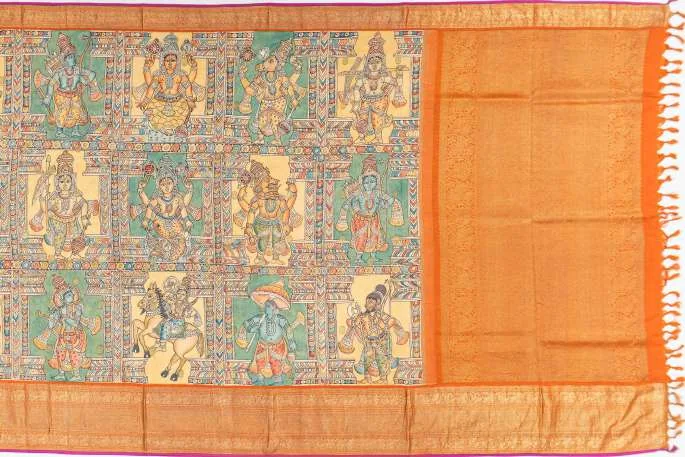
Kalamkari
Srikalahasti, Andhra Pradesh
The weave
A story drawn across a cloth.
A bamboo kalam carries the line by hand. From qalam, pen, and kari, work: a painting tradition with a textile ground.
The border and the pallu
A painted story can meet a woven border. Traditionally, plain cotton receives the drawing. Today, Kalamkari is also painted on silk and other textile grounds. The border and pallu may be painted, woven or both. The underlying sari determines their construction.
Before the first line
The cloth must be prepared to receive its colour.
Traditional process on cotton; silk grounds require adaptation.
Rare hallmark
The line comes first. Flowers, figures and stories grow from the movement of a pen. The woven cloth becomes the ground for another art.
The motifs
The colours
Black — An iron-and-jaggery preparation.
Red — Mordant-led dyeing, including madder.
Blue — Indigo.
Yellow — Myrobalan or pomegranate sources.
Brown — Earthy tones in the traditional palette.
Cream — The unpainted ground is part of the design.
Earth, plant and mineral. The cream ground between them. Colour alone cannot establish how a sari was made.
See it in print
Kalamkari as it appears in the book — motifs, colours, hallmarks and fold.
Open at page 67