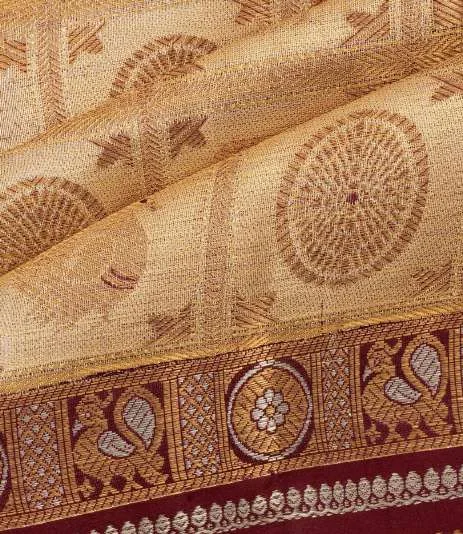
01 / The collection
Kanchipuram
Kanchipuram, Tamil Nadu
The weave
Mulberry silk in warp and weft meets three ply twisted silk.
Zari — silver thread twisted with silk, then gilded with gold. Three separate cloths — body, border and pallu, joined on the loom. Not sewn. Hence, known for contrast colours: body one colour, border another.
The border and the pallu
Korvai: border woven separately and locked to the body by an interlocked weft. Three shuttles, two weavers at either weft edge of one loom. Hence three shuttle weaving. Petni: joins the pallu to the body, with the interlock running along the warp instead.
Rare hallmark
Korvai needs two people on one loom at the same moment.
The join is the proof of hand. Korvai cannot be powerloomed.
The motifs
Unlike most silk sarees that are about 45 inches wide, Kanjivaram sarees are generally 48 inches, playing a canvas to the most vivid flora and fauna motifs.
The colours
Arakku — Lac. Oldest red dye source.
Kumkuma — Sindoor. The vermillion hue of red.
Kempu — Ruby.
Chembaruthi — Hibiscus. Red imbued with magenta, named for the flower offered at Kanchipuram's shrines.
Manjal — Turmeric. The yellow that runs through every South Indian ritual.
Vengayam — Onion. A dusty pink.
Kili Pacchai — Parrot green.
Naval Pazham — Jamun. The darkest purple.
The fold
The Kanchi fold
The saree is folded in successive halves, with the blouse folded in before the final folds. The last fold is arranged to leave the body, border and korvai clearly visible.
Crease parallel to the korvai, clear of the petni. Old households refold on a slightly different line each time so no permanent crease sets.
See it in print
Kanchipuram as it appears in the book — motifs, colours, hallmarks and fold.
Open at page 5