02 / The collection
Banarasi
Varanasi, Uttar Pradesh
The weave
A family of weaving traditions.
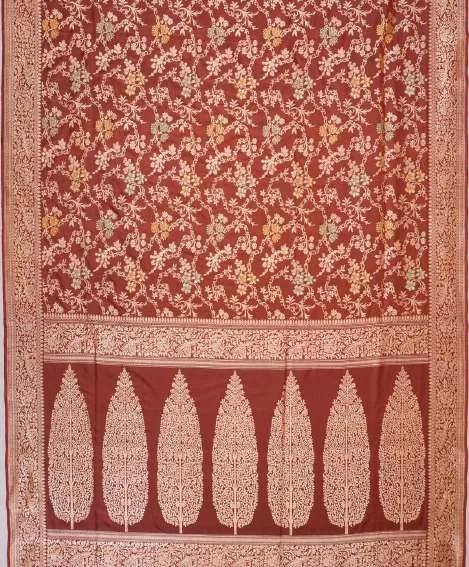
Silk and zari, flowers and foliage, a rich language of pattern. Rooted in Banaras and its neighbouring districts, with Mughal and Persian influences woven into its designs.
The many grounds
Banaras works across silk, organza, georgette, tissue and tussar. The ground changes the drape; the pattern changes its character. Satin gives a smooth, lustrous surface. A single sari may bring together several kinds of weaving and ornament.
The language of weaving
Gold and silver
Sona rupa: gold and silver zari in the same piece. Two tones of light, held in one cloth. Ganga-Jamuna: gold and silver brought together in butidar work, named for the two rivers.
Rare hallmark
Turn the sari over. The reverse reveals how the pattern was made.
Kadhwa: each motif is woven separately, with no long pattern-weft floats connecting one motif to the next. Cutwork or phekwa: the pattern weft travels across the width, and unwanted floats are cut away, leaving small ends.
Look between the motifs. The difference lies in the threads left behind.
The motifs
The colours
Red — A classic bridal colour.
Maroon — A deeper expression of the bridal palette.
Firozi — Turquoise, named for the stone.
The fold
The Banarasi long fold
Let the jaal read in one sweep. Fold lengthwise into a long, narrow panel and keep a continuous stretch of pattern visible.
The long format keeps the pattern connected, with fewer crosswise breaks in the visible jaal.
See it in print
Banarasi as it appears in the book — motifs, colours, hallmarks and fold.
Open at page 14