08 / The collection
Pochampally Ikat
Bhoodan Pochampally, Telangana
The weave
The design begins before the weaving.
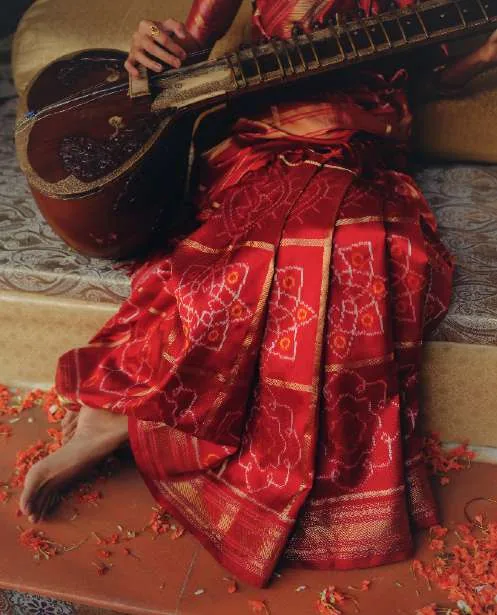
Bundles of yarn are tied and resist dyed. On the loom, their coloured sections align to become a pattern in cotton, silk or sico.
Single ikat. Double ikat.
Single ikat: either warp or weft carries the resist-dyed pattern. Double ikat: both carry it, and their dyed sections must meet in the right places as the cloth is woven.
Rare hallmark
A motif emerges as dyed threads meet. At its edge, small shifts in alignment leave the soft outline we recognise as ikat.
The feathered edge is a useful clue to yarn-resist work. Read it together with the structure and provenance of the cloth.
The motifs
Diamonds, checks and repeated blocks build the field. Birds, elephants and floral forms also appear in the living repertoire. Bundles of yarn favour rhythm and repetition. Curves are possible too, shaped through careful tying and alignment.
The colours
Red
Black
Ivory
Green
A long memory of red, black and white. Red, black and white recall the telia rumal tradition. Pochampally saris now range widely across colour, using both natural and synthetic dyes.
From kerchief to sari
Body, border and pallu patterns are planned before weaving. A border may use a dyed warp section; additional zari brings woven ornament. Pochampally has links with Chirala and the regional telia rumal tradition. Telia names the oil preparation used for that distinct cloth, also associated with Puttapaka. That preparation is not universal to modern ikat saris.
See it in print
Pochampally Ikat as it appears in the book — motifs, colours, hallmarks and fold.
Open at page 54