05 / The collection
Jamdani
Dhaka, Bangladesh; Phulia, West Bengal
The weave
Flowers that seem to float in the cloth.
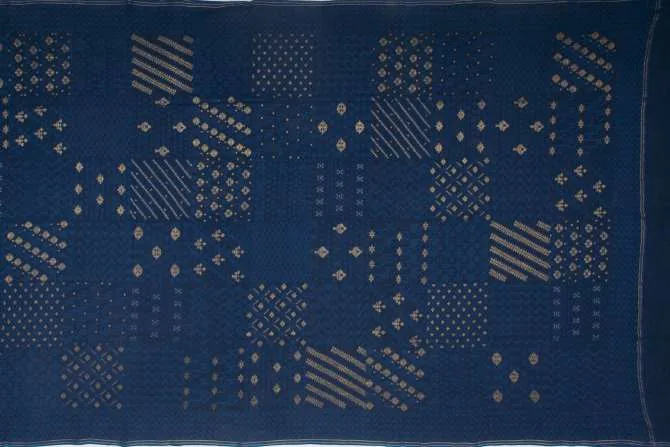
Fine cotton muslin carries motifs inserted by hand. The ground recedes; the pattern appears suspended in light.
The border and the pallu
The ground and motif grow together. A fine ground weft makes the cloth. A separate pattern weft builds each motif in the selected area, guided by hand. The border and pallu can gather these motifs into denser arrangements. The ornament is woven on the loom, not stitched onto finished cloth.
Rare hallmark
The motif catches the light differently from the fine ground. As the cloth moves, the flowers appear, soften and return.
A fine jamdani still asks us to look slowly.
The motifs
The names describe both the motif and the way it is arranged.
The colours
Off white
Gold
Silver
Nilambari — A deep blue ground.
An off-white ground with pale, dark or metallic motifs is a classic expression of jamdani. The contrast may be delicate: the yarns catch the light at different angles. Illustrative palette; colour does not determine fineness.
A Bengal inheritance
Dhaka and Sonargaon are historic centres. Weaving communities also carried their skills into West Bengal, including Phulia, through migration. Historic muslin inspired comparisons with air. Its extraordinary fineness depended on cotton, spinning skill and conditions suited to delicate yarn.
See it in print
Jamdani as it appears in the book — motifs, colours, hallmarks and fold.
Open at page 36