04 / The collection
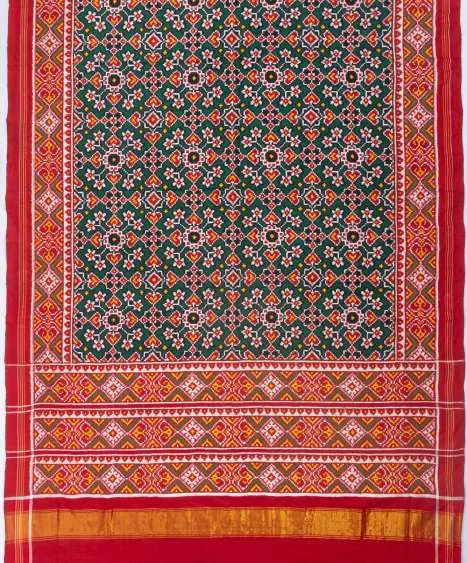
Patan Patola
Patan, north Gujarat
The weave
Double ikat in fine silk.
Both warp and weft are tied and resist dyed before the cloth is woven. The design is planned in two directions. It comes into focus when the dyed yarns meet correctly on the loom.
The border and the pallu
Body, border and pallu are planned in the dyed yarns. Their patterns emerge together in the weaving. Traditional Patan Patola saris have pallus at both ends. An additional zari strip may distinguish one end. On a slanting loom, alignment is adjusted by hand.
Before the cloth exists
Two sets of dyed yarn. One carefully matched pattern. The weaver calculates where every colour must fall, then adjusts the weft as each row is woven. Both yarn systems carry the design; their alignment brings the pattern together. In single ikat, only the warp or the weft carries the resist-dyed pattern.
Rare hallmark
Colour before cloth. A traditional saying holds that a Patola may tear, but its colour will not fade.
The design is carried by the yarn, not printed on the cloth.
The front and back carry the same colours and design, so the sari can be worn with either side facing out.
The motifs
Bhat means design. Ratan chowk, phulwadi, laheriya and akhrot bhat extend this rich repertoire of named designs.
See it in print
Patan Patola as it appears in the book — motifs, colours, hallmarks and fold.
Open at page 29